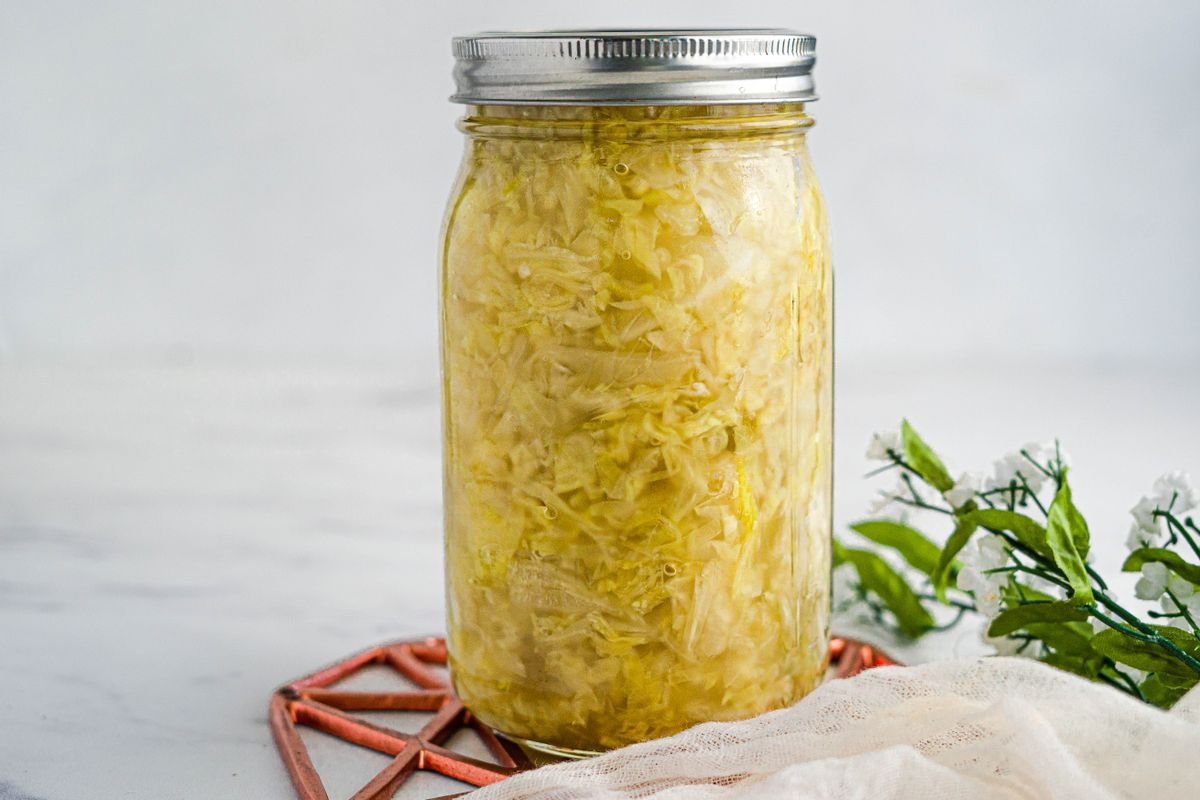
Best Sauerkraut
Sauerkraut is one of the most delicious fermented foods and one of our favorites! You can buy raw sauerkraut – typically at a high price at your local supermarket – or make your own at home using minimal ingredients and simple methods. Fresh cabbage is shredded and then layered with plenty of salt. The salt starts the entire process by drawing the water out of the cabbage leaves. The water and salt combine together to form a brine. The brine will begin to ferment the cabbage leaves into sauerkraut. Sauerkraut has many potential health benefits including introducing beneficial lactobacillus bacteria into your gut and it is also loaded with Vitamin C! The lactobacillus bacteria can convert the cabbage’s sugars into by-products like lactic acid and carbon dioxide (so you will know when fermentation has gotten underway when you see bubbles rising to the surface). The wonderful thing is that sauerkraut is naturally Low Carb, Keto, and Paleo friendly.
How to Make It
Step 1
Using a sharp knife or a mandolin (We like to use a Japanese mandolin for its lightweight and very sharp blade), slice the cabbage into thin strips about ⅜” thick. To do so, remove any outer leaves from the cabbage and discard them. Then, slice the cabbage in half and then into quarters. Take a sharp knife at an angle and cut out the core from each quarter. Place each quarter on the mandolin, slice it into thin pieces, or use a sharp knife to cut the cabbage. Place the cabbage into a large mixing bowl. The amount of cabbage here can easily be divided into two large bowls.
Step 2
Weigh the salt and sprinkle the salt evenly between the two bowls. Then, using your hands, massage the cabbage with the salt together to begin drawing the water from the cabbage. Do this process for a couple of minutes. Cover it for a half hour or so with plastic wrap and repeat the process. This helps the cabbage to release more liquid. You will want to keep repeating this process until you have extracted enough liquid that it will cover the cabbage once it is compressed into the jar.
Step 3
Transfer the cabbage into the glass jar or fermentation crock. Fill the contents of the container to only about ⅔ of the way full as the bubbles will push the cabbage up and will overflow. Push the cabbage down as hard as possible to compress it, bringing the brine up. Add a glass weight to the top if you have one.
Step 4
Add extra brine if there is not enough liquid. To do this, make a 2% salt solution (for example, 2 grams of salt to 100 g of water) and pour it over the top. If you have a previous batch of sauerkraut liquid, you can use this to get the process going by adding about 2-3 tbsp of that. Then, cover the top of the jar with cheesecloth and secure it to the top of the jar with a rubber band. You will want to watch the sauerkraut to ensure the cabbage stays beneath the brine. If not, make more salt solution and pour it on top. Place the jar in a cool, dark room at about 60-75 F. After a few days, you will see plenty of bubbles rising in the kraut jar. After about a week, you can taste some of the sauerkraut to see if it is at the right amount of sourness. Keep in mind that opening and closing the jar tends to increase the risk of growing mold, so always use clean hands and utensils! If there is mold on the surface, you can skim it off (discard the whole batch if it is orange mold, but white mold is ok). The kraut should be ready in about three weeks, but feel free to allow it to ferment for another week, up to six weeks or so. At that point, it should be sour and ready to be transferred to the fridge. Enjoy chilled!
Ingredients
- Cabbage
3 lb
- Coarse Kosher Salt
27 g